
Flea & Tick Control
Janus Pest Management
Service On Your Terms
One-Time | Monthly | EOM | Quarterly | Semi-Annual | Custom
Free site survey available.
Professional Flea & Tick Control San Gabriel Valley
The Janus Advantage: Advanced Protection Against Lyme Disease, Typhus & More
Southern California’s mild climate creates near year-round flea and tick activity — and the San Gabriel Valley’s mix of urban neighborhoods, foothill trails, and wildlife corridors makes exposure a genuine concern for families and pets alike. Effective control starts with identifying harborage areas, host activity, and entry points — then applying targeted treatments that break the breeding cycle at its source.
The San Gabriel Valley is home to three primary flea and tick species: the Cat Flea, the Western Black-Legged Tick, and the American Dog Tick — confirmed vectors for Murine Typhus, Lyme Disease, and Rocky Mountain Spotted Fever. Reducing populations on your property lowers your family’s and pets’ exposure to bites and, more importantly, reduces the risk of flea and tick-borne illness.
Janus Service Guarantee
Effective pest suppression—Guaranteed results: Sighting target pests between your scheduled visits? Janus will return and re-treat the area at no additional cost to you.
How We Control Fleas and Ticks
Professional Application & Coverage
We apply professional-grade materials to turf, landscape beds, harborage areas, and perimeter zones where fleas and ticks concentrate. Two chemistry options available:
- Green Chemistry: Eco-friendly botanical formulations for environmentally sensitive properties and families seeking reduced-risk solutions — effective against both adult fleas and larvae
- Traditional Chemistry: Multi-mode of action materials including Insect Growth Regulators (IGRs) combined with adulticides for maximum efficacy and extended residual control
Both treatment approaches target multiple life stages simultaneously — breaking the breeding cycle rather than simply knocking down adult populations. Service intervals are matched to flea and tick pressure on your property.
One-Time & Pre-Event Services
Moving into a new home? Dealing with a sudden infestation after a pet brings fleas inside? A targeted one-time treatment can rapidly reduce populations and provide relief. We also treat yards prior to outdoor gatherings where guests and pets will be present. Contact us 5–7 days before your event for best results.
IGR + Adulticide Combination — Breaking the Cycle
Fleas are notoriously difficult to eliminate with adulticides alone because pupae are resistant to chemical treatment. Our combination approach pairs an IGR (Insect Growth Regulator) with a fast-acting adulticide — the IGR prevents eggs and larvae from developing while the adulticide eliminates existing adults. This is the professional standard for flea infestations and delivers significantly better long-term results than over-the-counter products.
Vectors: Main Sources of Flea & Tick Risk in the SGV
Southern California’s mild climate means fleas are a year-round threat — and the San Gabriel Valley’s foothill corridors, open space, and urban wildlife bring two medically significant tick species directly into residential yards. One tick carries Lyme Disease, California’s most commonly reported tick-borne illness. The other is named for the host it prefers — and yours may already be bringing it inside.
These three species account for nearly all flea and tick-related health risks in the San Gabriel Valley. While our professional treatments target existing populations and harborage areas, effective long-term control requires a collaborative effort: treat your pets with veterinarian-recommended flea and tick prevention and reduce wildlife attractants on your property to disrupt the reinfestation cycle at the source.
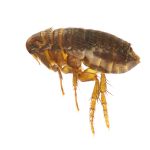
Cat Flea (Ctenocephalides felis)
- Activity Period: Year-round threat. Unlike seasonal pests, cat fleas remain active in Southern California’s mild climate throughout the year, with peak activity April through October when warm temperatures accelerate the breeding cycle.
- Hosts & Harborage: Opportunistic parasite. Despite the name, cat fleas infest dogs, cats, rabbits, and humans equally. Wildlife — particularly opossums and raccoons — are the primary carriers introducing fleas into residential yards. See transmission cycle →
- Bite Sites: General exposure. Targets any exposed skin but shows preference for ankles, feet, and lower legs. Bites appear as small red welts, often in clusters of three — commonly called “breakfast, lunch, and dinner” by pest professionals.
- Disease Vector: Primary vector for Murine Typhus (Rickettsia typhi) — a bacterial illness transmitted through infected flea feces, not the bite itself. LA County documents consistent local outbreaks annually, with 87% of reported cases requiring hospitalization. Also transmits Cat Scratch Disease and serves as an intermediate host for tapeworms.
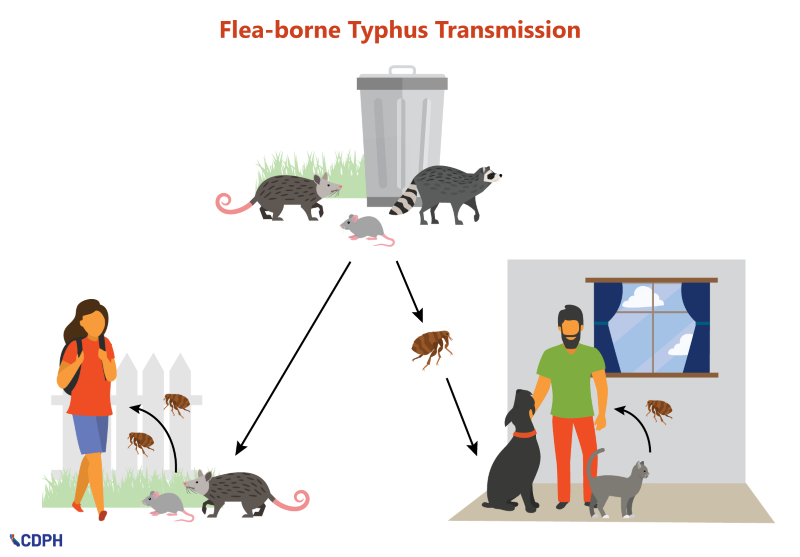
Flea-Borne Typhus Transmission Cycle
Opossums, raccoons, and rats are the primary wildlife reservoir for fleas in the San Gabriel Valley. Infected fleas transfer from these animals to your yard, your pets, and ultimately indoors — without any direct contact with wildlife required.
Source: California Department of Public Health (CDPH)
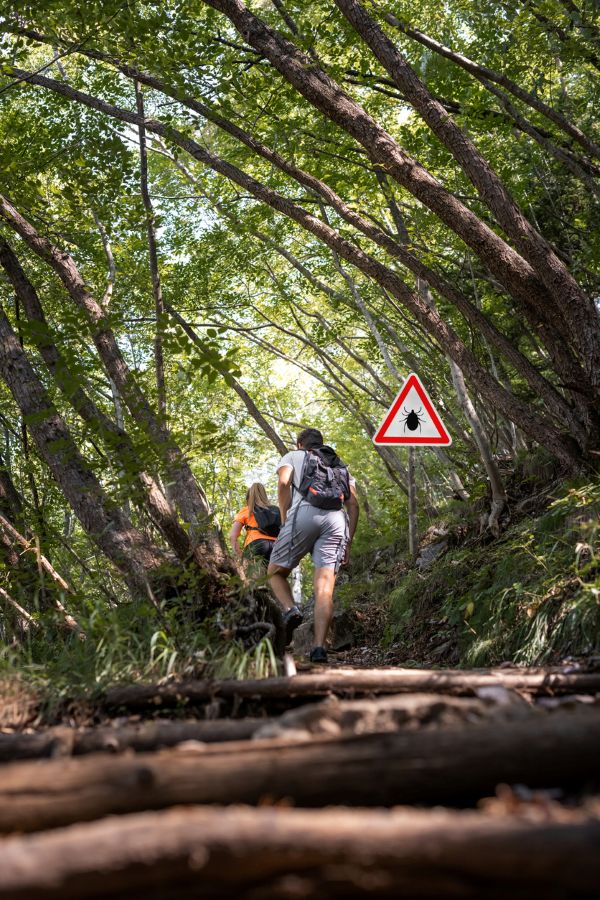
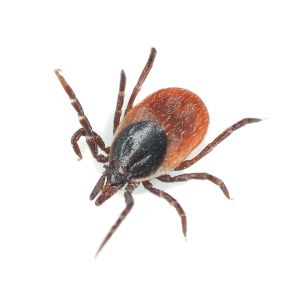
Western Black-Legged Tick (Ixodes pacificus) The Primary Vector for Lyme Disease in California
- Activity Period: Cool-season biter. Most active October through April — the opposite of most people’s expectations. Nymphs are active spring through early summer and are the most dangerous stage due to their poppy-seed size, which allows them to feed undetected for the 36–48 hours required to transmit disease.
- Habitat: Foothill corridors and trail edges. Prefers dense chaparral, leaf litter, tall grass, and the borders of hiking trails. In the SGV, properties adjacent to Claremont Hills, Puente Hills, and San Gabriel Mountain foothills carry the highest exposure risk. Adults climb vegetation and wait for passing hosts.
- Bite Sites: Warm, protected areas. Strongly prefers the scalp, behind the knees, groin, and armpits — areas that make detection difficult. Nymphs are frequently overlooked entirely due to their extremely small size.
- Disease Vector: The tick that carries Lyme Disease. Ixodes pacificus is the confirmed primary vector for Lyme Disease (Borrelia burgdorferi) in California — the most commonly reported tick-borne illness in the state. Also transmits Anaplasmosis and Hard Tick Relapsing Fever (Borrelia miyamotoi), first confirmed in California in 2022.
Know Your Vector: American Dog Tick (Dermacentor variabilis)
- Activity Period: Year-round but peak in spring. Active throughout the year in California’s mild climate, with adult activity peaking January through June. Unlike the Western Black-Legged Tick, this species is most active during warmer months and is commonly encountered during spring hiking and yard work season.
- Habitat: Chaparral, grasslands, and foothill edges. Thrives in the dry chaparral, coastal sage scrub, and grassland habitats characteristic of the SGV foothill interface. Commonly found questing on tall grass and low shrubs along the edges of open space, parks, and undeveloped lots bordering residential properties.
- Bite Sites: Exposed extremities and upper body. Targets the head, neck, and ears as well as ankles and legs. Larger than the Western Black-Legged Tick and more likely to be detected — however its painless bite and anesthetic saliva mean attachment often goes unnoticed.
- Disease Vector: Confirmed vector for Rocky Mountain Spotted Fever (Rickettsia rickettsii) — the deadliest tick-borne disease in the Western Hemisphere with a case fatality rate of 7–10% without prompt treatment. Also the sole vector for Pacific Coast Tick Fever (Rickettsia 364D), a spotted fever disease only identified in 2008 whose full disease burden is still being studied by CDPH.
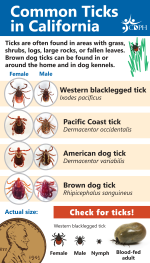
Know Your Ticks — Free CDPH Tick ID Card
California’s four medically significant tick species identified side-by-side with actual size reference and disease vectors. Download and save to your phone or request a free laminated copy from Janus — while supplies last.
ProTip: Tick & Flea Prevention Between Services
What happens between service visits determines how well treatment performs.
View Tips
Most flea and tick exposure happens in your own yard — not on trails. These CDC-recommended steps make the biggest difference between service visits:
- Treat your pets year-round — the single most effective step. Professional yard treatments perform significantly better when pets are already on veterinarian-recommended prevention.
- Mow frequently — short grass along fence lines and yard edges reduces harborage and increases heat exposure, making the environment significantly less hospitable for fleas and ticks.
- Remove debris — leaf litter, brush piles, and clutter are prime flea larval habitat and tick harborage. Rake regularly and keep woodpiles away from the structure.
- Seal wildlife attractants — store pet food and garbage in airtight containers. Opossums, raccoons, and rats are the primary carriers introducing fleas into residential yards.
- Check yourself and pets within two hours — after any outdoor activity, including yard work. Tumble dry clothes on high heat for 10 minutes to kill ticks on clothing.
Yard conditions between service visits directly affect how well treatment performs — and most of these steps cost nothing but time.
At Janus Pest Management, we recognize that effective flea & ticks control requires more than perimeter sprays — it requires understanding how each species exploits landscaping, moisture, and structural vulnerabilities to establish and persist in otherwise well-maintained properties.